
Wallets & vault accounts
Give each customer, merchant or business unit its own receiving accounts. Organize addresses and assets in a structure your team understands.
Receive deposits, manage treasury and send payments—with the security controls your business needs and the integrations your team expects.
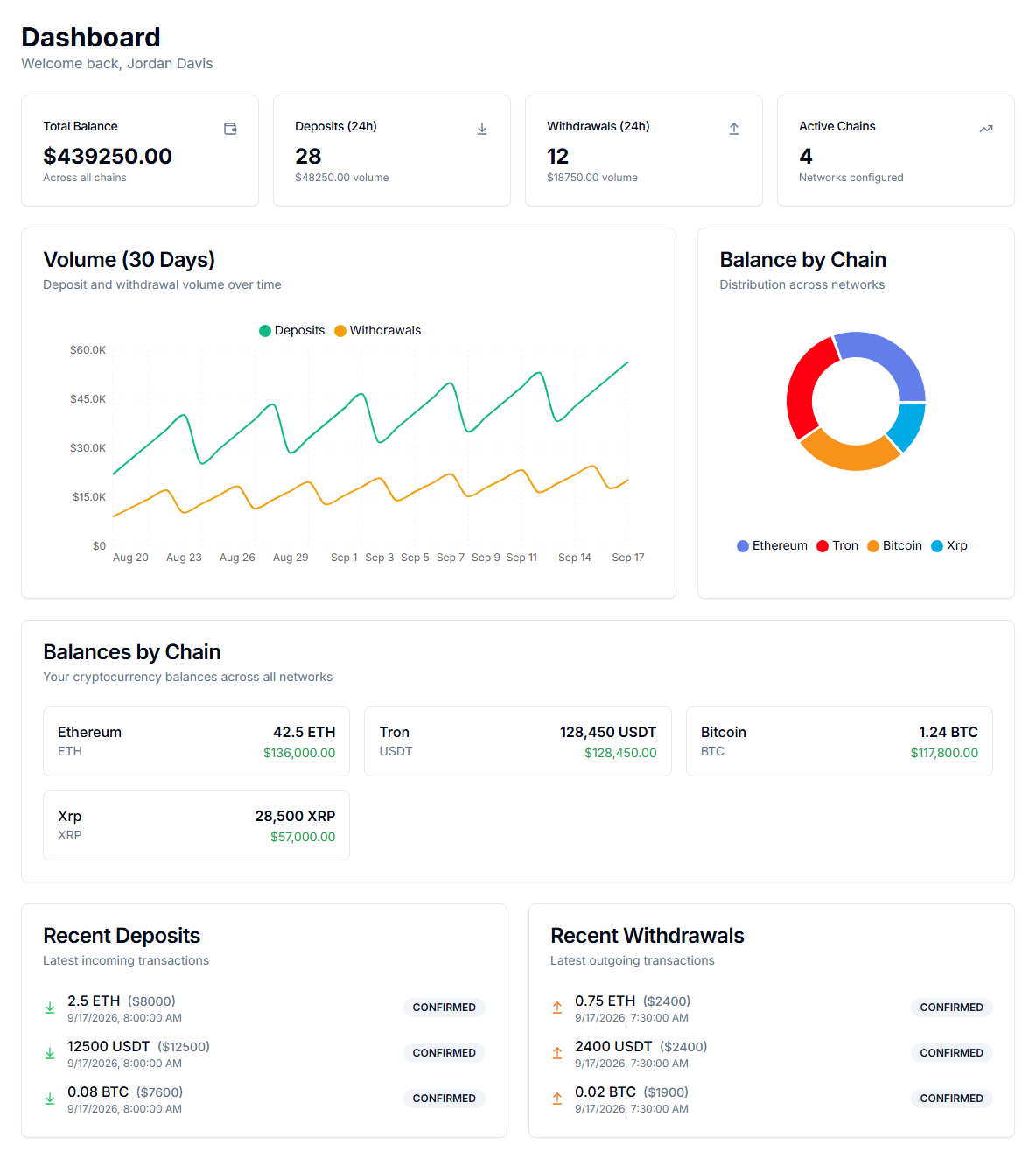
Manage assets together.
Keep each network in view.
Asset and signing availability depend on your configuration.
Bring us the networks and assets your business needs. We’ll agree integration scope and timing with your team.
From the first deposit address to the month-end statement, give finance and engineering a shared operational picture.
Give each customer, merchant or business unit its own receiving accounts. Organize addresses and assets in a structure your team understands.
Track incoming funds from detection through network confirmation. Know what has arrived, what is pending and what is available.
Prepare single or multi-recipient payments, review fees and follow each withdrawal through approval, signing and confirmation.
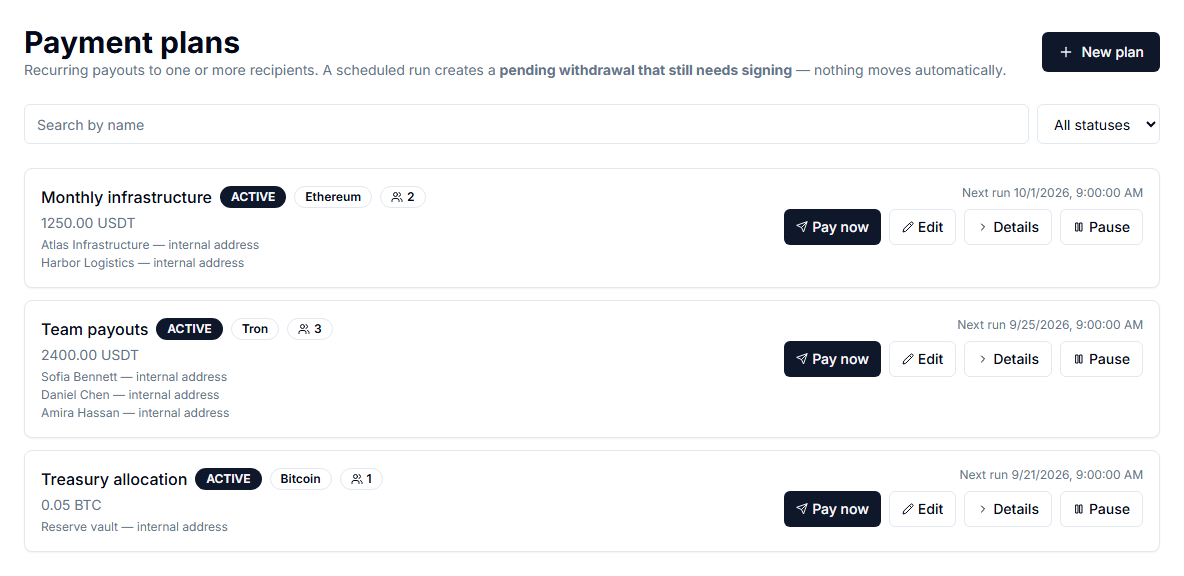
Save recipients and schedule one-time, daily, weekly or monthly payouts. Scheduled payments enter your signing workflow for review.
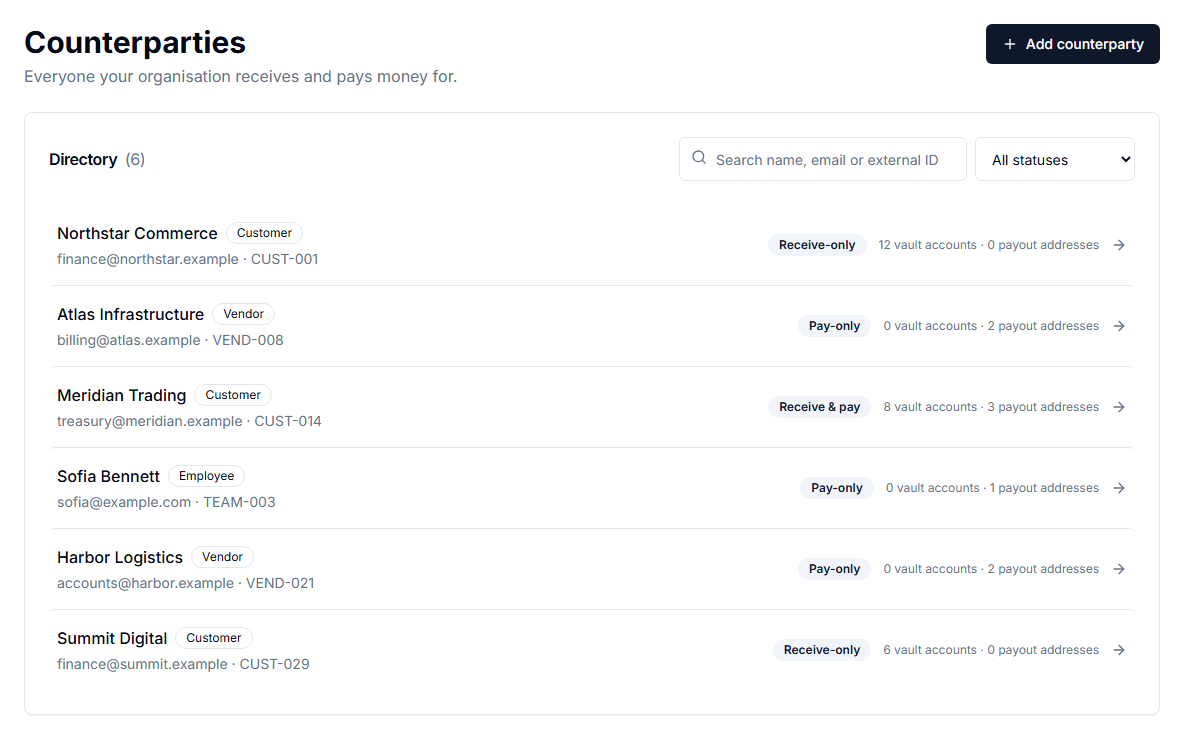
Keep receiving accounts and payout destinations alongside the people and businesses behind them. See received and paid flows per asset.
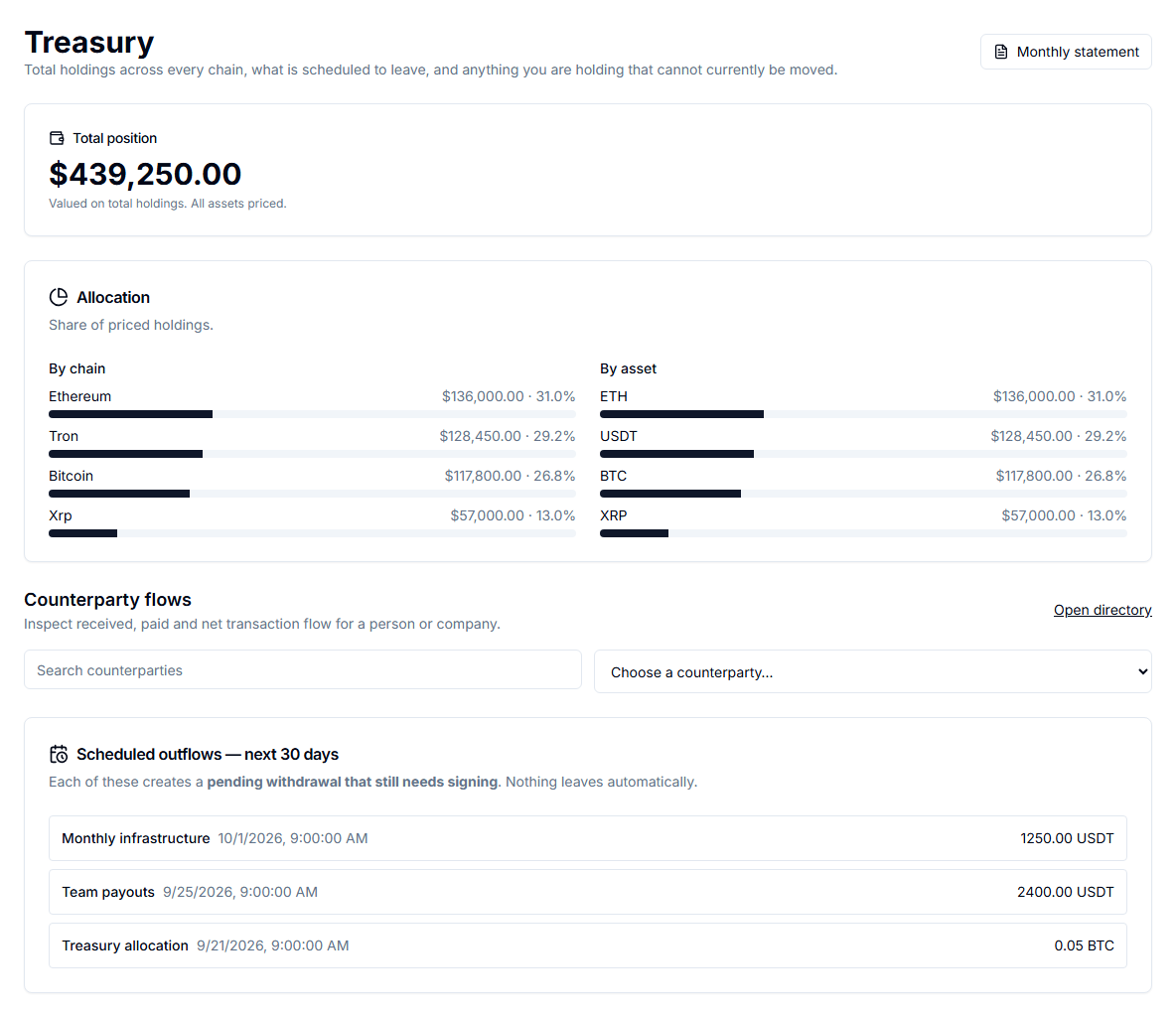
See balances, asset allocation and upcoming outflows together. Export transaction records and monthly statements for reconciliation.
Actual Aegis screens in English with demo data. Take a closer look at the tools your operations team will use every day.
See where your assets sit and what is scheduled to leave. Give finance a shared view of balances, allocation and upcoming payouts.
Save recipients and payment schedules for suppliers, contractors and recurring settlements. Each run prepares a pending withdrawal that still goes through signing.
Bring customers, vendors and your team into one directory. Link deposit accounts and saved payout addresses, then follow received, paid and net transaction flows.
Security belongs in the daily workflow: who has access, what they can do and how a payment gets signed.
MPC signing distributes key material across separate participants. The signing policy is defined by your custody configuration.
Separate owner, finance and support permissions. Add two-factor authentication and IP restrictions for portal and API access.
Keep payment preparation, approval and signing visible. Review the asset, amount and recipient before authorizing a transfer.
Use the desktop signing station with Ledger or Trezor for supported assets and signing setups.
Device-secured wallets use customer-held recovery material and recovery drills. Build a recovery plan before you need one.
Authenticate API requests with HMAC signatures, restrict access by IP and verify the signatures on incoming webhook events.
Managed-key setups support encrypted storage backed by a key-management service, adding protection for sensitive key material at rest.
Audit records capture authenticated API activity and payment signing events, helping your team trace actions and investigate issues.
Build wallet operations into your own platform, and bring the updates your team needs to the tools they already use.
Create vault accounts and deposit addresses. Work with balances, withdrawals and transaction history through authenticated endpoints.
Receive deposit and withdrawal lifecycle events. Verify signatures and use delivery retries to support your event-driven workflows.
Connect your workspace for transaction notifications and wallet queries, with role and channel visibility controls.
Link team accounts and chats for deposit alerts, withdrawal updates, balances and transaction queries.
Use compatible hardware wallets through the Aegis signing station. Network support depends on the device and signing setup.
Export deposits, withdrawals and monthly treasury statements for reconciliation and downstream reporting.
Connect an exchange, payment gateway, fintech app or internal treasury tool through the API. Use webhooks to connect transaction events to your own business logic.
/api/v1/addresses/generate{
"walletId": "YOUR_WALLET_ID"
}deposit.pending
→ deposit.confirming
→ deposit.confirmedHMAC authentication required. Your integration supplies the wallet ID and request signature.
Run crypto operations in the workspace, or connect Aegis to your own product. Start with the job your team needs to get done.
When customer payments arrive across wallets and networks, your team needs a clear way to attribute and track them.
A clear connection between the counterparty, the incoming payment and its status.
Recurring supplier and partner payouts should not start with rebuilding a recipient list every time.
Reuse payment instructions while keeping authorization in the workflow.
Paying multiple people means keeping recipient details, amounts, assets and payment status organized.
One operational process for a payment run, from recipient selection to finance records.
Your customers use your interface. Your team still needs the wallet infrastructure and operational visibility behind it.
Keep your customer experience while giving operations a shared wallet workspace.
A customer-facing payment flow needs a connection between your application logic and the team handling funds.
Connect collections, business events and outgoing payments through API and webhooks.
Balances spread across assets and networks make it harder to plan payments and explain where funds moved.
A shared view for the people planning payments and the people closing the books.
Generate an address, identify the counterparty and follow the deposit to confirmation.
Prepare the payment. Check the asset, recipient, amount and fees with the right team access.
Authorize through your configured signing flow and follow the outgoing transaction.
Connect payment activity to counterparties and export records for your finance workflow.
Your business rules stay in your application. Aegis provides the wallet, payment and operational controls you connect to them.
Security, integrations and everyday operations.
Talk to the teamAegis combines configurable signing models with team permissions, two-factor authentication, IP restrictions and authenticated integrations. Customer-device signing for newly generated device-secured keys requires your device to participate. Hardware-wallet signing is also available for supported setups. We work through the right configuration for your operation during onboarding.
Signing authority depends on the key and custody configuration. Newly generated device-secured keys require your device to participate; Aegis alone cannot sign. Managed signing and existing or migrated keys have different guarantees. Customer-device signing is in preview, and the exact setup is agreed during onboarding.
Aegis implements Bitcoin, Ethereum, TRON and XRP Ledger integrations, including supported ERC-20 and TRC-20 assets. Additional networks—including Solana, BNB Chain, Polygon, Base, Arbitrum and Avalanche—can be discussed as part of a custom integration. They are not available in the standard offering today; we agree scope and timing with you. Asset and signing availability for existing integrations depends on your configuration and is confirmed before onboarding.
Use the REST API and signed webhooks to connect your own exchange, fintech app, payment gateway or treasury tool. Slack and Telegram integrations bring notifications and wallet queries to team chat. CSV exports and monthly statements support your finance workflows. Ledger and Trezor connect through the signing station for supported setups.
No. A schedule prepares a pending withdrawal for the normal signing workflow. Payment plans let you reuse recipients and timing while keeping the required authorization in place.
Recovery for device-secured wallets depends on keeping the required recovery material. Setup and recovery drills help you prepare. Losing every enrolled device and the necessary recovery material can make funds unrecoverable, including by Aegis.
Contact sales with the networks you use, your payment workflows and your security requirements. We can walk through the platform, discuss integration and signing options, and agree the commercial scope and onboarding plan.
Tell us what you need to receive, manage and pay.
We’ll walk through the platform and the setup that fits.